
Celebrating Joplin: the King of Ragtime
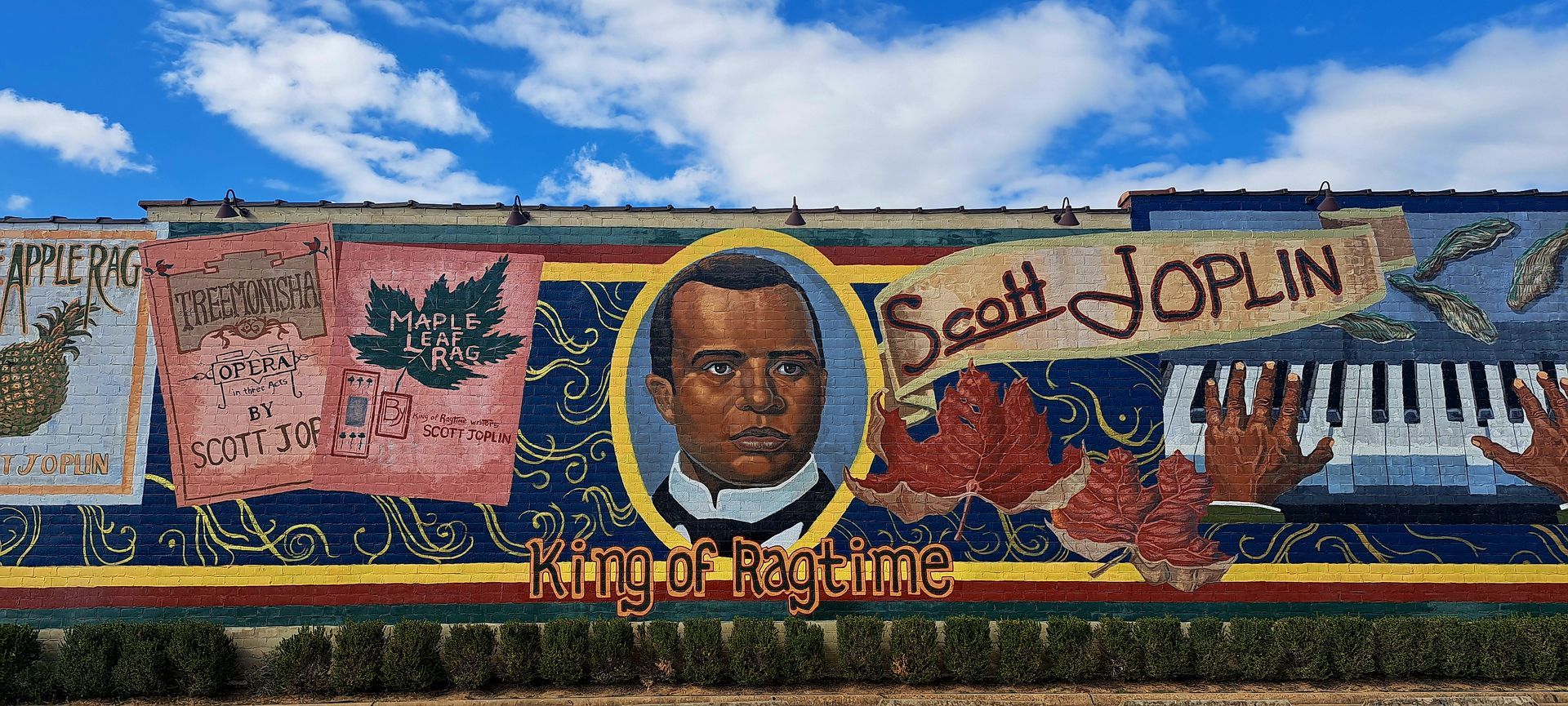
By P.A. Geddie
The Scott Joplin Support Group spearheaded an upgrade to the Scott Joplin downtown Texarkana mural to change his title from “Father of Ragtime” to the more well-known “King of Ragtime.” Texarkana artist Art Pletcher, designer of the 2015 renovation of the original painting, made the adjustments in October.
This change coincides with an upcoming exhibition featuring Joplin in New York City. Ragtime: Cakewalk in Pianoland is on exhibit from November 13 through June 13, 2027, at The Morgan Library & Museum. Coordinators say aspects of the exhibition will be in their online offerings on themorgan.org.
The Morgan exhibit includes a painting from the nine-piece Scott Joplin’s Texarkana Collection by artist Henry Fort II. The 2020 mixed media oil and applied stones on canvas was acquired at auction by Thomas and Leah Orr and is now on loan to The Morgan. Also in the exhibit is a replica of Texarkana’s Joplin mural.
Scott Joplin grew up in humble surroundings in Linden and Texarkana to become the “King of Ragtime,” and he died more than 50 years after his music earned an Academy Award and the opera he composed won a Pulitzer Prize.
Ragtime is an infectious dance music that features syncopated, or “ragged,” rhythms that grew, at least partially, out of John Philip Sousa marches combined with African rhythms. Joplin did not create the music — which researchers said began in dancehalls in St. Louis and New Orleans — but quickly became its royalty.
The bare bones of Joplin’s biography are simple.
He was born as the second of six children of Florence Givins and Giles Joplin near Linden on, by most accounts, November 24, 1868, the first of several well known musicians from the town including bluesman Aaron “T-Bone” Walker and rocker Don Henley.
When he was seven years old, the young Joplin moved with his family to Texarkana. He was already playing banjo and was just beginning to learn to play the piano that would make him famous.
Joplin’s mother cleaned homes and he practiced his music on pianos in those homes. His mother, who also played banjo, and father, who helped lay rail tracks and played fiddle, bought him a piano in 1882 and he received free lessons that gave him a well-rounded knowledge of classical music form.
By his teens, Joplin was part of a minstrel troupe in Texarkana and then played in dancehalls, saloons, and brothels across the Midwest.
He settled in Sedalia, near St. Louis, in the early 1890s, where he studied music composition at George Smith College and honed his already considerable skills into a national touring act with his eight-member Texas Medley Quartette.
In 1911, he moved to New York City where he produced his own opera, “Treemonisha,” said to be the first grand opera composed by an American of African descent. He staged the opera himself at great personal expense but it was performed only once during his lifetime, in 1915.
Joplin died on April 1, 1917, in Manhattan State Hospital after a long illness, and is buried in St. Michael’s Cemetery in the Astoria section of Queens.
His most famous compositions, perhaps, include “Maple Leaf Rag,” “The Chrysanthemum,” “Elite Syncopations,” “The Entertainer,” “Eugenia,” “The Ragtime Dance,” and more including “Treemonisha.”
Ragtime music began to wane in popularity about the same time as Joplin’s death, although it lived on in the music of Jelly Roll Morton, Eubie Blake, and a number of others including classical composers Igor Stravinsky and Claude Debussy.
The music — most commonly played on piano — had a renaissance in the 1970s because of the Marvin Hamlisch score of Joplin’s songs in the Paul Newman/Robert Redford movie The Sting. That score won an Academy Award and then the revived opera won the coveted Pulitzer Prize in 1976. In 1983, the U.S. Postal Service released a commemorative Joplin stamp.
The Pulitzer and the other honors became posthumous awards for an artist who persevered to be taken seriously.
Students at The New England Conservatory of Music recorded “The Red Back Book,” a collection of Joplin’s rags, in 1973; that collection won a Grammy and lead to the music’s use in The Sting.
It was Joplin’s publication in sheet music of “Maple Leaf Rag” — with its melody lines, harmonic progressions, and metric patterns — in 1899, followed by other popular songs, that brought the music to the bigger public’s attention until the growth of jazz, which, in the way of one form of music superseding another, often incorporated ragtime. Both ragtime and jazz are sometimes called American forms of minuets by Mozart and other European classical music. Some “hillbilly” — as country musicians were called at the time — string bands and folk-blues musicians also incorporated ragtime.
Joplin’s presence is all over Texarkana. Besides the mural, there’s a permanent Scott Joplin exhibit in the Museum of Regional History that includes a square piano he once played and a bronze bust by the late artist Bonita Leslie. There are three historical markers including one at a National Register of Historic Places designation for the Orr School he attended.
The Joplin Group is working with The Morgan crew on a travel package to see the exhibition that includes Amtrak’s Texas Eagle from the historic Texarkana Union Station straight through to Penn Station in New York. This would be the route that Joplin took in his travels. The package includes hotel accommodations near The Morgan and reduced admission. Get more information about that and Joplin on the group’s Facebook page.
Historical excerpts in this article are from the November 2012 County Line Magazine.
